Last updated: October 2026
The best travel management software for a small business brings booking, policy controls, and expense visibility into one place without adding enterprise-level overhead. For teams with tight budgets, the strongest option is usually the one that prevents overspend before booking, reduces manual admin after a trip, and has a pricing model that matches actual travel volume. It should also cut planning time: employees search and book within policy in one place, approvals route automatically, and booking data flows into expenses without re-keying.
Without that structure, work travel creates a surprising amount of shadow work. Someone chases booking confirmations, someone else reconciles receipts, and the travel policy sits in a document that nobody sees when they book.
Modern travel management software changes that. Employees can book flights, hotels, rail, and cars within company rules, while travel and spend data stays visible from the moment a trip is approved through month-end.
This guide compares nine travel management platforms for small and mid-sized businesses, with particular attention to setup, pricing transparency, inventory, traveler support, and the connection between booking and expense management.
TL;DR — Key takeaways
- The best budget-friendly travel solution combines self-service booking, policy controls, and expense automation, so savings are protected before and after a trip.
- Perk is a strong fit for small and mid-sized teams that need broad travel inventory, flexible cancellations, and travel-connected expense management in one platform.
- Navan is a strong alternative for mid-market teams that want a unified travel, card, and expense experience.
- Low travel volume usually favors per-booking pricing. Frequent travel often makes a monthly plan more economical.
- For companies of roughly 50 to 500 employees, prioritize policy enforcement at booking, accounting integrations, reporting, and reliable traveler support over a long feature list.
What is travel management software?
Travel management software is a platform that centralizes how a company books, manages, pays for, and reports on work travel. It gives travelers a single place to book while giving the company visibility and control over policy, approvals, and spend.
A basic tool may only cover flight and hotel booking. A full travel and expense platform connects the complete trip lifecycle: flights, hotels, rail, car rental, travel policy, approvals, card payments, receipts, expense reports, and reporting. The result is fewer handoffs between the traveler, approver, and finance team.
For a growing business, that connection matters. A platform that works for 20 employees should still support multiple policies, legal entities, approval paths, and finance integrations as the team reaches 200 or more. Perk’s travel and spend platform is designed around that model, connecting travel bookings, expenses, invoices, and payments in one system.
Why travel management software matters for small businesses
Travel management software matters because unmanaged travel costs more than the fare or hotel rate. It also creates admin work, policy exceptions, reimbursement delays, and incomplete spend data that finance teams have to sort out later.
When employees book through consumer sites, a company often loses the ability to apply spending limits before payment. Finance then has to untangle receipts, confirm business purpose, match transactions, and correct out-of-policy purchases after the money has left the business. That is shadow work: necessary tasks that pull people away from real work.
According to The Cost of Shadow Work, a Forrester Consulting study commissioned by Perk in September 2025, employees spend an average of seven hours each week on non-core work. Travel administration is a familiar source of that lost time, particularly in lean teams where one person may manage travel, expenses, payroll, and operations.
The right platform shifts control earlier in the process. Policy rules guide travelers when they search, approval workflows route automatically, and booking data flows into expense records. That creates cleaner data, stronger compliance, and a clearer view of committed travel spend before month-end.
How to choose the right travel management tool
The right travel management tool should fit your travel volume, policy needs, finance setup, and budget model. The cheapest subscription is not automatically the lowest-cost option once booking fees, manual administration, and unrecovered cancellations are included.
Use the following criteria to compare cost-effective travel management for your business:
For teams with tight budgets, three practices have the biggest impact. Set realistic price caps by route or city, make in-policy options easy to book, and centralize booking so every trip is visible. These controls help companies run economical travel programs without forcing employees into impractical itineraries.
A travel policy and approval workflow should be configurable without engineering support. Look for a platform that can route exceptions automatically, apply different rules for different teams, and show employees what is in policy before they commit to a booking.
The best travel management software for small businesses
The best platform depends on whether you need a complete travel and spend workflow, a finance-led card program, or a lightweight way to centralize bookings. The comparison below highlights where each option fits best.
Perk — Best for teams that want travel and spend in one platform
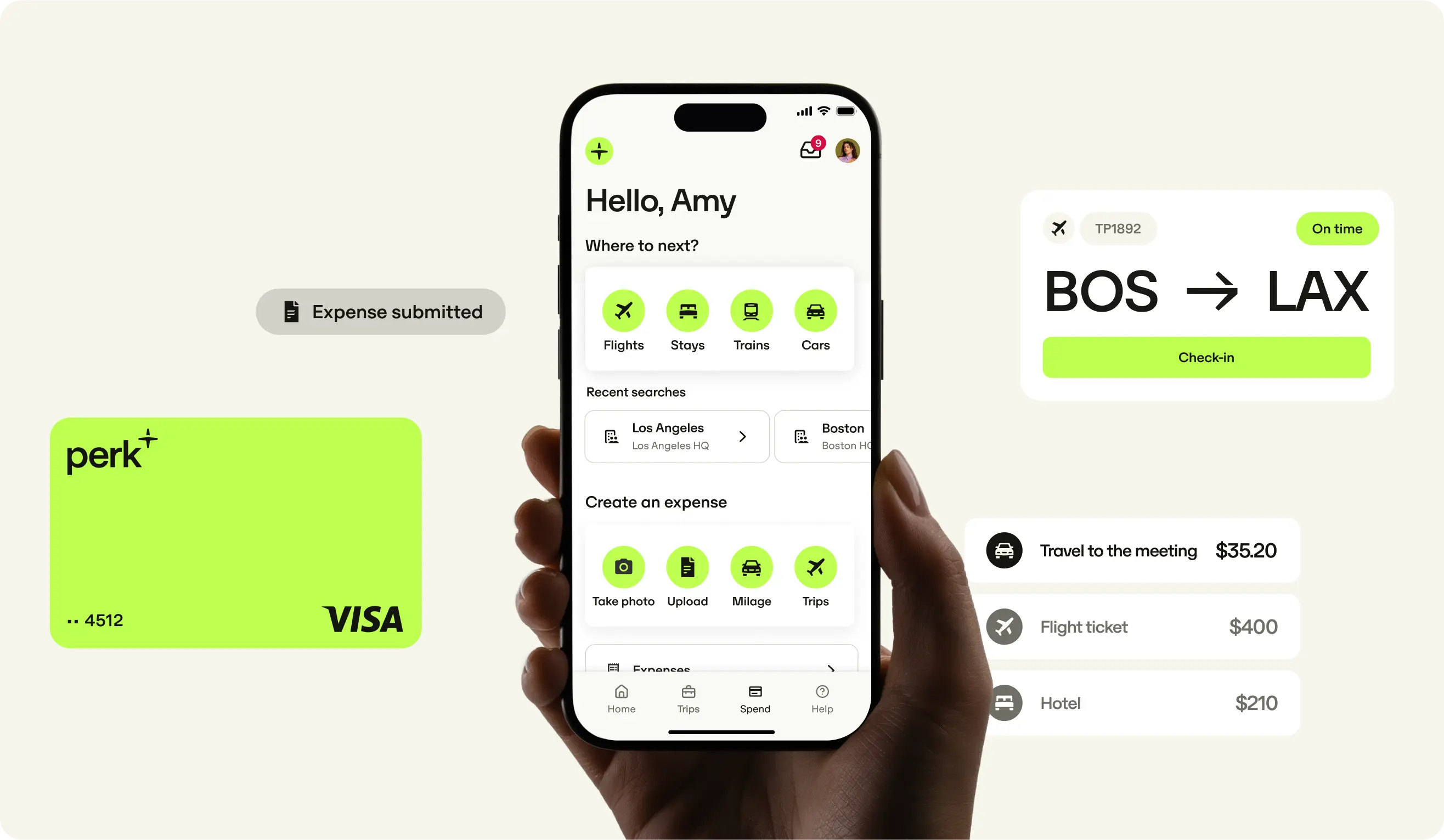 Perk is a strong option for small and mid-sized businesses that want to control travel costs without stitching together separate booking, card, and expense tools. It connects work travel and spend in one platform, so bookings, receipts, card transactions, and policy checks can move through a single workflow.
Perk gives travelers broad choice while keeping budgets visible. The platform includes 25 direct NDC airline connections, more than 36,000 negotiated hotel rates, rail options including Deutsche Bahn, SNCF, and Eurostar, plus low-cost carriers such as Ryanair and EasyJet. That breadth is particularly useful for companies with European travel patterns, where rail and low-cost carrier availability can make a material difference to trip cost.
For a company with a tight budget, flexibility also matters. FlexiTravel allows eligible bookings to be canceled for up to 80% back as travel credit, helping recover value when meetings change or projects move. Rather than treating cancellations as an unavoidable loss, teams can build flexibility into their travel program.
The platform also joins booking and expense workflows. When employees book through Perk, the booking data can create the basis for an expense record, while AI helps capture and match receipts. With expense processing, teams can reduce the manual work of checking, categorizing, and reconciling travel costs. Eligible companies can also use Perk corporate cards to connect card transactions to expense management and access up to 1% cashback.
Perk’s North American travel plans are designed for different stages of growth:
Perk includes 24/7 human travel support on every plan, with a target response time of under 60 seconds. That matters when a delayed flight, missed connection, or urgent change needs a fast resolution, not another queue or a chatbot loop.

Navan — Best for mid-market teams needing enterprise features
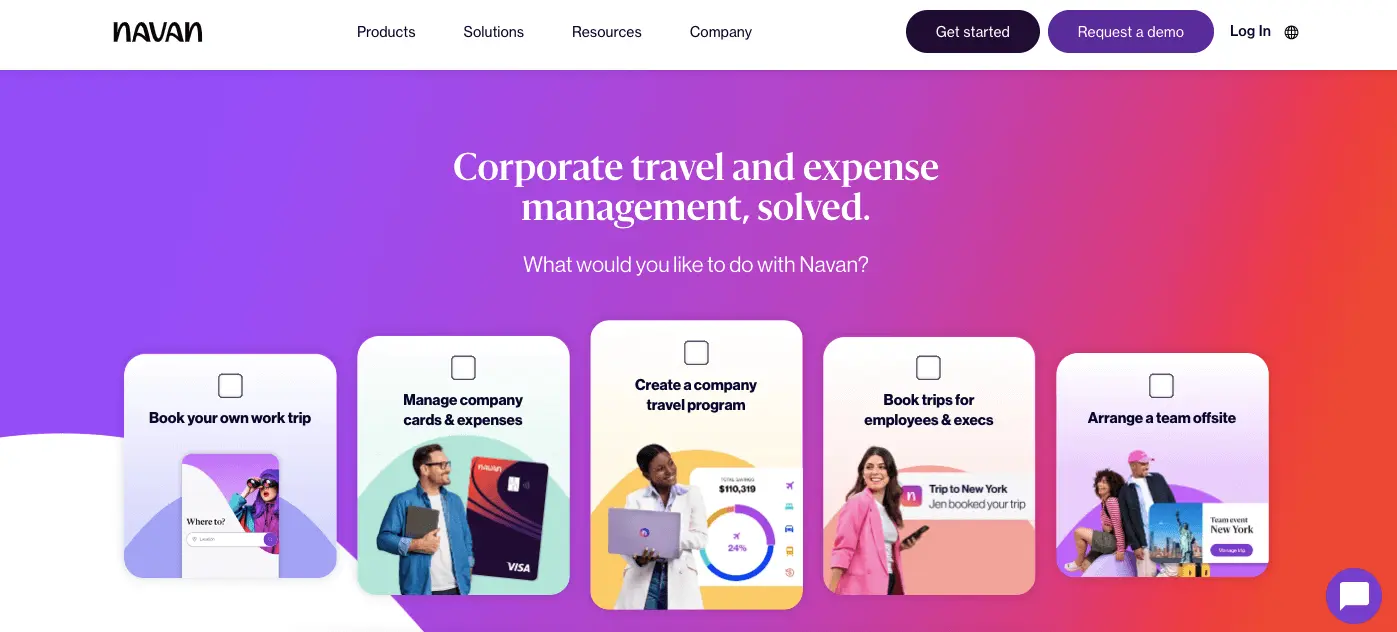
Navan is a strong option for mid-sized companies that want travel, expense management, and card controls within a single proprietary system. Its mobile-first experience, automated policy rules, and unified visibility make it relevant for teams moving beyond unmanaged travel.
For companies with approximately 50 to 500 employees, Navan is worth evaluating alongside Perk when the priority is a unified travel and expense environment. Its travel offering has no platform fee, while its expense product is free for the first five expensing users and then priced per user for eligible businesses.
The key evaluation point is total cost and flexibility. Companies that already use another expense platform should confirm whether they want to replace that workflow or keep it. Mid-sized companies should also test the quality of relevant hotel and rail inventory, how exception approvals work, and what support looks like for a traveler during a disruption.
Ramp: Best for finance teams prioritizing spend control
 Ramp is best suited to teams that begin with corporate cards, expense controls, and accounts payable automation, then want travel within that finance-led setup. Its strength is real-time visibility into company spend and card-based controls.
For a company already using Ramp, adding its travel capabilities can reduce the number of tools employees use. The trade-off is that travel is part of a wider spend management proposition rather than the core product focus. Teams with frequent international trips, rail travel, or complex itinerary needs should compare inventory depth and traveler support carefully against a dedicated travel platform.
If cards and payment controls are the main priority, Ramp is a credible choice. If the company needs travel booking, policy, flexible changes, and expenses to work as one connected program, an integrated travel and spend platform may be a better fit.
Brex: Best for high-growth startups
 Brex is a good fit for high-growth startups that want corporate cards, global payments, expenses, and travel features in one finance-led platform. Its free Essentials tier can be appealing for companies that are managing cash carefully while building a more formal spend program.
The platform is strongest when card control is the starting point. Approvals and policy rules can be tied to company spending, while travel booking sits within the broader Brex ecosystem. Companies with a specialized travel program should assess whether the available inventory, change management, and traveler assistance meet their day-to-day needs.
BizAway: Best budget option for European SMBs
 BizAway is a practical option for European small businesses that want centralized online booking and basic policy management at a low per-user price. It can work well when the program is straightforward and the company does not need a deep travel and expense workflow.
For budget-conscious teams, the appeal is simple pricing and a lightweight setup. However, businesses should account for the added work that can arise when expense automation, card reconciliation, or advanced reporting require separate tools. The subscription cost is only one part of the total travel program cost.
Routespring: Best for teams without corporate cards
 Routespring is a useful choice for teams that want centralized payment for work travel without asking employees to use personal cards. Its virtual card and centralized payment model can remove reimbursement delays and improve visibility at the point of booking.
This can be especially useful for distributed teams, contract workers, or occasional travelers. Companies with predictable travel patterns and limited expense needs may find the active-traveler pricing attractive. Teams that need detailed expense processing, broader spend controls, or advanced reporting may need additional software.
Expensify: Best for simple expense reporting
 Expensify is best for small businesses whose main problem is receipt capture and reimbursement rather than travel program management. Its SmartScan functionality and straightforward reporting flow make it a low-friction way to replace paper receipts and spreadsheet claims.
For companies with occasional travel, Expensify can be a sensible component of the stack. Once travel volume grows, however, teams often need a dedicated booking platform that applies policy before a trip is booked and keeps itinerary data connected to expenses.
Zoho Expense: Best for teams in the Zoho ecosystem
 Zoho Expense is a cost-effective choice for businesses already using Zoho Books, Zoho CRM, or Zoho People. It covers core expense needs, including receipt capture, mileage, per diems, approvals, and multi-currency reporting.
Its value is strongest when the company’s finance and operations workflows already sit in Zoho. Travel booking is less comprehensive than a dedicated travel management platform, so teams with regular flights, rail travel, hotel bookings, or complex policy requirements may need to add a specialist travel tool.
SAP Concur: Best for large enterprises
 SAP Concur is best suited to large organizations with complex compliance requirements, deep ERP integration needs, and the resources to manage a more involved implementation. It combines travel, expense, and invoice capabilities with global compliance and SAP connectivity.
For most small businesses, it is more platform than they need. The implementation effort, configuration depth, and enterprise pricing model can make it difficult to justify for a team that needs to move quickly. Mid-sized companies should only prioritize Concur when SAP integration, audit requirements, or multi-entity complexity outweigh the need for a lighter user experience.
How Perk approaches travel management differently
Perk approaches travel management as a connected travel and spend workflow, not just a booking portal. The aim is to remove the work that happens between booking a trip and closing the books.
A trip is rarely just a flight and a hotel. It also involves approvals, policy decisions, payment, receipts, expense categories, accounting data, possible changes, and traveler support. When each step lives in a different tool, teams end up moving information manually. Perk keeps those steps connected so travel bookings can flow into expense management, and finance teams can see committed and actual spend without rebuilding the trail after the fact.
That is particularly valuable for mid-sized companies. At 50, 100, or 300 employees, the volume of trips may be too high for a shared inbox and spreadsheet but not large enough to justify a heavyweight enterprise system. Perk gives these teams configurable policies, automated approvals, travel reporting, and smart spend controls without treating every booking as a manual finance task. Because bookings, expenses and spend data sit in one place, teams can use reporting and saved traveler preferences to see how they actually book and refine policies and budgets over time.
Perk also gives companies the flexibility to build around their current setup. Businesses can use native spend capabilities in supported regions or connect with existing finance tools through travel and spend integrations. This helps teams improve travel management without forcing a complete finance stack replacement on day one.
Traveler experience supports compliance, too. When people can find practical in-policy options, manage changes quickly, and reach a real person when something goes wrong, they are more likely to book through the company program. That protects both cost control and duty of care.
Frequently asked questions
- The best solution is one that balances low platform cost with controls that prevent waste.
For low-volume teams, Perk Starter offers free platform access with a 5% booking fee capped at $30, while its travel policy, broad inventory, and support help teams avoid the hidden costs of unmanaged travel.The right choice depends on total cost, not just subscription price. Compare booking fees, travel volume, cancellation risk, expense administration, support, and the time your team spends reconciling trips. - Look for a platform that handles the whole trip in one place. Employees search and book flights, hotels, rail, and cars within company rules, so there is no back-and-forth over what is allowed. Approvals route automatically and only out-of-policy trips need a decision. Booking data creates the basis for an expense record, and receipts are captured and matched with less manual entry. Human support during changes saves the traveler and the office manager from rebooking by hand. Perk and Navan both take this connected approach.
- Look for a platform with a mobile app that covers the whole trip: booking and changing travel, flight check-in, mobile tickets and 24/7 human support. Perk and Navan both offer mobile apps, and Perk's is rated 4.7 on the App Store and Google Play.
- Look for software that turns booking history into better future trips. That usually means saved traveler preferences for repeat bookings, reporting on where, when and how far ahead your team books, and visibility of policy exceptions so you can adjust budgets and rules. AI features are growing in this area. Navan offers AI-driven booking recommendations, and Perk uses AI to capture and match receipts and has launched an MCP that lets teams book travel and submit expenses through AI assistants.
- For mid-sized companies, Perk and Navan are strong platforms to compare. Perk is particularly well suited to companies that value broad travel inventory, flexible cancellation, 24/7 human support, and travel-connected expense management. Navan is a strong option for teams that want a proprietary travel, card, and expense stack.
The deciding factors are usually current finance tools, travel patterns, policy complexity, and whether the company needs to support European rail, VAT recovery, and flexible bookings. - A traditional travel management company provides managed services, often with agents who book and manage travel on a company’s behalf. Travel management software gives employees a self-service platform for booking within policy while automating approvals, reporting, expense capture, and support.Modern platforms such as Perk combine both approaches. Routine bookings can be handled through self-service, while travelers can still access human support for changes and disruptions.
- Yes, if the team travels regularly or spends meaningful time managing reimbursements and bookings. The value comes from avoiding out-of-policy purchases, reducing receipt chasing, and giving the company a complete view of travel spend.For a smaller team with occasional trips, a free or low-commitment plan can be a practical starting point. As booking volume grows, the savings from automated policy controls and expense processing become more significant.
- Yes. Many platforms integrate with accounting and expense systems, allowing companies to improve travel booking and policy control without replacing every finance tool at once. Perk supports integrations through its travel and spend marketplace and offers expense management integrations for North American teams.The best setup depends on how much of the expense workflow you want inside the travel platform. Companies with frequent travel often benefit most when bookings and expense records are directly connected.
- Look for policy rules that apply while employees book, not after a receipt is submitted. The tool should let you set price caps, preferred suppliers, cabin rules, and approval thresholds, then route exceptions to the right person automatically.A good policy tool also gives travelers enough relevant options to book practical trips. Policies work best when they guide behavior rather than creating a separate approval process for every booking.
- Travel management software supports duty of care by giving companies itinerary visibility, traveler tracking, risk alerts, and a way to contact employees during disruptions. Perk’s traveler tracker helps teams see where people are traveling, while its 24/7 human support helps travelers manage urgent changes.For additional protection, eligible travelers can add medical and baggage insurance during booking.
Written by

Product Marketing Manager